





Saxon Wine Trail - Stage 3
From Wilder Mann to Radebeul-Zitzschewig
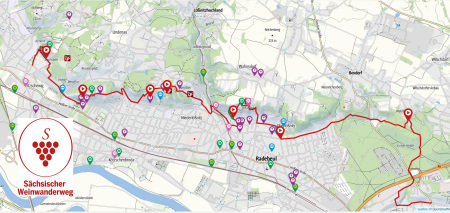
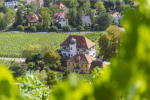
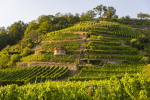
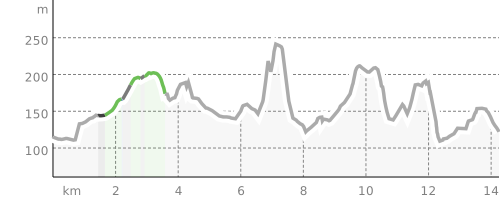
The third stage of the Saxon Wine Trail starts at "Wilder Mann" in Dresden and runs for around 14 kilometres to Radebeul-Zitzschewig. The idyllic section in Radebeul with its terraced vineyards is a highlight of the route and leads past the longest staircase in Saxony (Spitzhaustreppe) and the historic Hoflößnitz winery. The route continues past the Radebeul water tower to Europe's first adventure winery, Schloss Wackerbarth, which invites you to take a break. The stage ends above the tram stop in Zitzschewig.
© Sylvio Dittrich
© Sylvio Dittrich
© Sylvio Dittrich
© Sylvio Dittrich
© Sylvio Dittrich
© Sylvio Dittrich
From the ‘Dresden, Wilder Mann’ stop (the terminus of tram line 3) on Großehainer Straße, we walk a short way up the street until we turn left into Schützenhofstraße. We first pass through the Trachau district, where viticulture was introduced in 1446. The route takes us along tarmac roads through housing estates dating from the last century and through the villas on the hillsides. We find evidence of the former wine-growing tradition, for example, in Schützenhofstraße (vineyard at the ‘Alter Trachenberge’, remains of old walls, terraces and steps) and on Galileistraße (a steep former vineyard staircase, which you reach by turning right after house number 50 on Schützenhofstraße).
We follow Galileistraße, turn right into Neuländer Straße (playground), turn left onto Moritzburger Landstraße and pass under the motorway. Shortly afterwards, a path on the right leads into the woods and we follow forest paths (crossing the Semmelweg, the Boxdorfer Weg and a short stretch of the Augustusweg, which , at the first junction, leads us right along a forest path back to the Boxdorfer Weg ) to the ‘Waldmax’ restaurant (on Waldhofstraße).
Behind the restaurant, the route continues along the forest path to the Augustusweg (with hidden references to winegrowing (vineyard roads, rubble stone walls) to the former ‘Baumwiese’ hotel (at the so-called ‘Baumwiese’ or the Boxdorf Baumwiese bus stop).
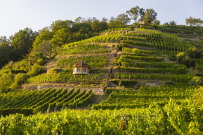
We cross Dresdner Straße, walk a short distance through the woods above Augustusweg until we meet Augustusweg and follow it to Radebeul, where a particularly idyllic stretch of the Wine Trail begins. Terraced vineyards with roughly 400-year-old rubble-stone walls, steep narrow steps and winegrowers’ cottages bear witness to the area’s historic wine-growing tradition.
At Eduard-Bilz-Platz, we turn right into Eduard-Bilz-Straße, which merges into Weinbergstraße. Now we also come across the modern-day wine industry: on Weinbergstraße – considered by some residents to be Radebeul’s most beautiful street, situated directly below the vineyard terraces – several small wineries are lined up one after the other. Here and there, there is the opportunity to sample rare wines. With wine on our minds, we now discover architectural gems such as‘Haus Sorgenfrei’, the former Bilz Sanatorium (now flats), or the‘Bennoschlösschen’ with its Renaissance gables in the midst of a vineyard.
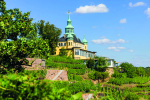
At Haus Lorenz, a half-timbered winegrower’s house dating from 1680, we turn right into Weberstraße, which merges into the narrow Eggersweg. This leads through the‘Goldener Wagen’ vineyard up to the Spitzhaus (restaurant). From up here, we have a breathtaking view of the Elbe Valley, the vineyard landscape and Radebeul.
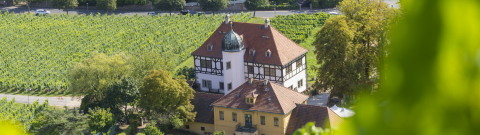
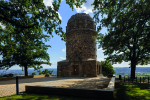
We continue along Spitzhausstraße, past the Bismarck Tower and the viewing platform at its foot. From there, it’s just a few steps to the Muschelpavillon, where we descend via the Spitzhaus Staircase – Saxony’s longest flight of steps – to the historic Hoflößnitz vineyard estate. By now, at the very latest, it’s time for a longer break – to visit the Winegrowing Museumin the Berg- und Lusthaus or the eco-certified winery with its ‘Sächsische Weinstraße’ visitor centre, which provides information on the entire wine-growing region.
Passing through the large gate to the vineyard complex, we follow Knohllweg to Hoflößnitzstraße and the striking Meinhold Tower House (now the Karl-Friedrich Aust Winery). Even though we’re now back on tarmac roads (Weinbergstr., right into Lößnitzgrundstr., left into Hoflößnitzstr., left into Lößnitzgrundstr., right onto Paradies- and Dr.-Rudolf-Friedrichs-Straße, left onto Jägerhofstraße, Auf den Bergen, left onto Höhenweg, left onto Obere Burgstr.), we can still enjoy the sight of lovingly restored manor houses and winegrowers’ cottages time and again. Vineyards line the route and the Radebeul water tower, visible from afar, greets us. After the steep descent (Burgstraße), to the right of the inaccessible Friedensburg, we turn right into Obere Bergstraße and pass the 1st Saxon Sparkling Wine Cellar (“Bussard”, now a residential complex) until we reach the few steps leading to Moritzburger Straße.
Even before we reach Obere Bergstraße, it’s worth taking a detour from Burgstraße by turning left into Bodelschwinghstraße and walking almost to the end of it, where a steep flight of steps leads up on the left (past the Besenschänke Haselbusch), taking you to just below Friedensburg (private property). From there, standing in the middle of the vineyard, you have a fantastic view of the Elbe Valley and Radebeul.
Following Moritzburger Straße downhill, we turn into Mohrenstraße (playground; continues as ‘Auf den Ebenbergen’), where we reach the Ebenberge (passing the wine tavern ‘Weinwirtschaft am Neufriedstein’). The ‘Adolph Diesterweg’ Planetarium points the way down to the Jacobstein, a vineyard pavilion dating from 1743, and finally, past the Belvedere and the vineyard terraces, down to the Saxon State Winery at Schloss Wackerbarth, which features a restaurant and a farm shop. Europe’s first ‘experience winery’ invites visitors to take part in guided tours of its wine, sparkling wine and park facilities, complete with tastings; the extensive Baroque park is open to the public all year round.
Passing the castle, we head towards the western park gate (entrance opposite the restaurant and shop), which leads us onto Mittlere Bergstraße; we walk straight on along this road until we reach Hohenhausweg. We turn right onto this road and leave it again at Hohenhaus (information board; now a residential building; opposite: Zechstein Winery holiday flat, 0351/656 3679) to turn left onto Zechsteinweg, which features an educational trail on Saxon grape varieties. A short while later, via Langenbergweg, we reach the junction of Mittlere Bergstraße and Gerhart-Hauptmann-Straße, and thus the end of Stage 3 in Radebeul-Zitzschewig (above the Gerhart-Hauptmann-Straße tram stop). Not far from the end of the stage, there is accommodation available, for example at the Annelore Große holiday flat (Mittlere Bergstraße 27c, 0351/838 3434 or 0174/246 3854).
From the ‘Dresden, Wilder Mann’ stop (the terminus of tram line 3) on Großehainer Straße, we walk a short way up the road until we turn left into Schützenhofstraße. We first walk through the Trachau district, where viticulture was introduced in 1446. The route takes us along tarmac roads through housing estates dating from the last century and through the villas on the hillsides. We find evidence of the former wine-growing tradition, for example, on Schützenhofstraße (vineyard at the ‘Alter Trachenberge’, remains of old walls, terraces and steps) and on Galileistraße (a steep former vineyard staircase, which you reach by turning right after house number 50 on Schützenhofstraße).
We follow Galileistraße, turn right into Neuländer Straße (playground), turn left onto Moritzburger Landstraße and pass under the motorway. Shortly afterwards, a path on the right leads into the woods and we follow forest paths (crossing the Semmelweg, the Boxdorfer Weg and a short stretch of the Augustusweg, which , at the first junction, leads us right along a forest path back to the Boxdorfer Weg ) to the ‘Waldmax’ restaurant (on Waldhofstraße).
Behind the restaurant, the route continues along the forest path to the Augustusweg (with hidden references to winegrowing (vineyard roads, rubble stone walls) to the former ‘Baumwiese’ hotel (at the so-called ‘Baumwiese’ or the Boxdorf Baumwiese bus stop).
We cross Dresdner Straße, walk a short distance through the woods above Augustusweg until we meet Augustusweg and follow it to Radebeul, where a particularly idyllic stretch of the Wine Trail begins. Terraced vineyards with roughly 400-year-old rubble-stone walls, steep narrow steps and winegrowers’ cottages bear witness to the area’s historic wine-growing tradition.
At Eduard-Bilz-Platz, we turn right into Eduard-Bilz-Straße, which merges into Weinbergstraße. Now we also come across the modern-day wine industry: on Weinbergstraße – considered by some residents to be Radebeul’s most beautiful street, situated directly below the vineyard terraces – several small wineries are lined up one after the other. Here and there, there is the opportunity to sample rare wines. With wine on our minds, we now discover architectural gems such as‘Haus Sorgenfrei’, the former Bilz Sanatorium (now flats), or the‘Bennoschlösschen’ with its Renaissance gables set amidst a vineyard.
At Haus Lorenz, a half-timbered winegrower’s house dating from 1680, we turn right into Weberstraße, which merges into the narrow Eggersweg. This leads through the‘Goldener Wagen’ vineyard up to the Spitzhaus (restaurant). From up here, we have a breathtaking view of the Elbe Valley, the vineyard landscape and Radebeul.
We continue along Spitzhausstraße, past the Bismarck Tower and the viewing platform at its foot. From there, it’s just a few steps to the Muschelpavillon, where we descend via the Spitzhaus Staircase – Saxony’s longest flight of steps – to the historic Hoflößnitz vineyard estate. By now, at the very latest, it’s time for a longer break – to visit the Winegrowing Museumin the Berg- und Lusthaus or the eco-certified winery with its ‘Sächsische Weinstraße’ visitor centre, which provides information on the entire wine-growing region.
Passing through the large gate to the vineyard complex, we follow Knohllweg to Hoflößnitzstraße and the striking Meinhold Tower House (now the Karl-Friedrich Aust Winery). Even though we’re now back on tarmac roads (Weinbergstr., right into Lößnitzgrundstr., left into Hoflößnitzstr., left into Lößnitzgrundstr., right onto Paradies- and Dr.-Rudolf-Friedrichs-Straße, left onto Jägerhofstraße, Auf den Bergen, left onto Höhenweg, left onto Obere Burgstr.), we can still enjoy the sight of lovingly restored manor houses and winegrowers’ cottages time and again. Vineyards line the route and the Radebeul water tower, visible from afar, greets us. After the steep descent (Burgstraße), to the right of the inaccessible Friedensburg, we turn right into Obere Bergstraße and pass the 1st Saxon Sparkling Wine Cellar (“Bussard”, now a residential complex) until we reach the few steps leading to Moritzburger Straße.
Even before we reach Obere Bergstraße, it’s worth taking a detour from Burgstraße by turning left into Bodelschwinghstraße and walking almost to the end of it, where a steep flight of steps leads up on the left (past the Besenschänke Haselbusch), taking you to just below Friedensburg (private property). From there, standing in the middle of the vineyard, you have a fantastic view of the Elbe Valley and Radebeul.
Following Moritzburger Straße downhill, we turn into Mohrenstraße (playground; continues as ‘Auf den Ebenbergen’), where we reach the Ebenberge (passing the wine tavern ‘Weinwirtschaft am Neufriedstein’). The ‘Adolph Diesterweg’ Planetarium points the way down to the Jacobstein, a vineyard pavilion dating from 1743, and finally, past the Belvedere and the vineyard terraces, down to the Saxon State Winery at Schloss Wackerbarth, which features a restaurant and a farm shop. Europe’s first ‘experience winery’ invites visitors to take part in guided tours of its wines, sparkling wines and grounds, complete with tastings; the extensive Baroque park is open to the public all year round.
Passing the castle, we head towards the western park gate (entrance opposite the restaurant and shop), which leads us onto Mittlere Bergstraße; we walk straight on along this road until we reach Hohenhausweg. We turn right onto this road and leave it again at Hohenhaus (information board; now a residential house; opposite: Zechstein Winery holiday flat, 0351/656 3679) to turn left onto Zechsteinweg, which features an educational trail on Saxon grape varieties. A short while later, via Langenbergweg, we reach the junction of Mittlere Bergstraße and Gerhart-Hauptmann-Straße – and thus the end of Stage 3 in Radebeul-Zitzschewig (above the Gerhart-Hauptmann-Straße tram stop). Not far from the end of the stage, there is accommodation available, for example at the Annelore Große holiday flat (Mittlere Bergstraße 27c, 0351/838 3434 or 0174/246 3854).
From the ‘Dresden, Wilder Mann’ stop (the terminus of tram line 3) on Großehainer Straße, we walk a short way up the road until we turn left into Schützenhofstraße. We first walk through the Trachau district, where viticulture was introduced in 1446. The route takes us along tarmac roads through housing estates dating from the last century and through the villas on the hillsides. We find evidence of the former wine-growing tradition, for example, on Schützenhofstraße (vineyard at the ‘Alter Trachenberge’, remains of old walls, terraces and steps) and on Galileistraße (a steep former vineyard staircase, which you reach by turning right after house number 50 on Schützenhofstraße).
We follow Galileistraße, turn right into Neuländer Straße (playground), turn left onto Moritzburger Landstraße and pass under the motorway. Shortly afterwards, a path on the right leads into the woods and we follow forest paths (crossing the Semmelweg, the Boxdorfer Weg and a short stretch of the Augustusweg, which , at the first junction, leads us right along a forest path back to the Boxdorfer Weg ) to the ‘Waldmax’ restaurant (on Waldhofstraße).
Behind the restaurant, the route continues along the forest path to the Augustusweg (with hidden references to winegrowing (vineyard roads, rubble stone walls) to the former ‘Baumwiese’ hotel (at the so-called ‘Baumwiese’ or the Boxdorf Baumwiese bus stop).
We cross Dresdner Straße, walk a short distance through the woods above Augustusweg until we meet Augustusweg, and follow this to Radebeul, where a particularly idyllic stretch of the Wine Trail begins. Terraced vineyards with roughly 400-year-old rubble-stone walls, steep narrow steps and winegrowers’ cottages bear witness to the area’s historic wine-growing tradition.
At Eduard-Bilz-Platz, we turn right into Eduard-Bilz-Straße, which merges into Weinbergstraße. Now we also come across the modern-day wine industry: on Weinbergstraße – considered by some residents to be Radebeul’s most beautiful street, situated directly below the vineyard terraces – several small wineries are lined up one after the other. Here and there, there is the opportunity to sample rare wines. With wine on our minds, we now discover architectural gems such as‘Haus Sorgenfrei’, the former Bilz Sanatorium (now flats), or the‘Bennoschlösschen’ with its Renaissance gables in the midst of a vineyard.
At Haus Lorenz, a half-timbered winegrower’s house dating from 1680, we turn right into Weberstraße, which merges into the narrow Eggersweg. This leads through the‘Goldener Wagen’ vineyard up to the Spitzhaus (restaurant). From up here, we have a breathtaking view of the Elbe Valley, the vineyard landscape and Radebeul.
We continue along Spitzhausstraße, past the Bismarck Tower and the viewing platform at its foot. From there, it’s just a few steps to the Muschelpavillon, where we descend via the Spitzhaus Staircase – Saxony’s longest flight of steps – to the historic Hoflößnitz vineyard estate. By now, at the very latest, it’s time for a longer break – to visit the Winegrowing Museumin the Berg- und Lusthaus or the eco-certified winery with its ‘Sächsische Weinstraße’ visitor centre, which provides information on the entire wine-growing region.
Passing through the large gate to the vineyard complex, we follow Knohllweg to Hoflößnitzstraße and the striking Meinhold Tower House (now the Karl-Friedrich Aust Winery). Even though we’re now back on tarmac roads (Weinbergstr., right into Lößnitzgrundstr., left into Hoflößnitzstr., left into Lößnitzgrundstr., right onto Paradies- and Dr.-Rudolf-Friedrichs-Straße, left onto Jägerhofstraße, Auf den Bergen, left onto Höhenweg, left onto Obere Burgstr.), we can still enjoy the sight of lovingly restored manor houses and winegrowers’ cottages time and again. Vineyards line the route and the Radebeul water tower, visible from afar, greets us. After the steep descent (Burgstraße), to the right of the inaccessible Friedensburg, we turn right into Obere Bergstraße and pass the 1st Saxon Sparkling Wine Cellar (“Bussard”, now a residential complex) until we reach the few steps leading to Moritzburger Straße.
Even before we reach Obere Bergstraße, it’s worth taking a detour from Burgstraße by turning left into Bodelschwinghstraße and walking almost to the end of it, where a steep flight of steps leads up on the left (past the Haselbusch wine tavern), taking you to just below Friedensburg Castle (private property). From there, standing in the middle of the vineyard, you have a fantastic view of the Elbe Valley and Radebeul.
Following Moritzburger Straße downhill, we turn into Mohrenstraße (playground; continues as ‘Auf den Ebenbergen’), where we reach the Ebenberge (passing the wine tavern ‘Weinwirtschaft am Neufriedstein’). The ‘Adolph Diesterweg’ Planetarium points the way down to the Jacobstein, a vineyard pavilion dating from 1743, and finally, past the Belvedere and the vineyard terraces, down to the Saxon State Winery at Schloss Wackerbarth, which features a restaurant and a farm shop. Europe’s first ‘experience winery’ invites visitors to take part in guided tours of its wine, sparkling wine and park facilities, complete with tastings; the extensive Baroque park is open to the public all year round.
Passing the castle, we head towards the western park gate (entrance opposite the restaurant and shop), which leads us onto Mittlere Bergstraße; we walk straight on along this road until we reach Hohenhausweg. We turn right onto this road and leave it again at Hohenhaus (information board; now a residential building; opposite: Zechstein Winery holiday flat, 0351/656 3679) to turn left onto Zechsteinweg, which features an educational trail on Saxon grape varieties. A short while later, via Langenbergweg, we reach the junction of Mittlere Bergstraße and Gerhart-Hauptmann-Straße – and thus the end of Stage 3 in Radebeul-Zitzschewig (above the Gerhart-Hauptmann-Straße tram stop). Not far from the end of the stage, there is accommodation available, for example at the Annelore Große holiday flat (Mittlere Bergstraße 27c, 0351/838 3434 or 0174/246 3854).
From the ‘Dresden, Wilder Mann’ stop (the terminus of tram line 3) on Großehainer Straße, we walk a short way up the road until we turn left into Schützenhofstraße. We first walk through the Trachau district, where viticulture was introduced in 1446. The route takes us along tarmac roads through housing estates dating from the last century and through the villas on the hillsides. We find evidence of the former wine-growing tradition, for example, on Schützenhofstraße (vineyard at the ‘Alter Trachenberge’, remains of old walls, terraces and steps) and on Galileistraße (a steep former vineyard staircase, which you reach by turning right after house number 50 on Schützenhofstraße).
We follow Galileistraße, turn right into Neuländer Straße (playground), turn left onto Moritzburger Landstraße and pass under the motorway. Shortly afterwards, a path on the right leads into the woods and we follow forest paths (crossing the Semmelweg, the Boxdorfer Weg and a short stretch of the Augustusweg, which , at the first junction, leads us right along a forest path back to the Boxdorfer Weg ) to the ‘Waldmax’ restaurant (on Waldhofstraße).
Behind the restaurant, continue along the forest path to the Augustusweg (with hidden references to winegrowing (vineyard roads, rubble stone walls) to the former ‘Baumwiese’ hotel (at the so-called ‘Baumwiese’ or the Boxdorf Baumwiese bus stop).
We cross Dresdner Straße, walk a short distance through the woods above Augustusweg until we meet Augustusweg, and follow this to Radebeul, where a particularly idyllic stretch of the Wine Trail begins. Terraced vineyards with roughly 400-year-old rubble stone walls, steep narrow steps and winegrowers’ cottages bear witness to the area’s historic wine-growing tradition.
At Eduard-Bilz-Platz, we turn right into Eduard-Bilz-Straße, which merges into Weinbergstraße. Now we also come across the modern-day wine industry: on Weinbergstraße – considered by some residents to be Radebeul’s most beautiful street, situated directly below the vineyard terraces – several small wineries are lined up one after the other. Here and there, there is the opportunity to sample rare wines. With wine on our minds, we now discover architectural gems such as‘Haus Sorgenfrei’, the former Bilz Sanatorium (now flats), or the‘Bennoschlösschen’ with its Renaissance gables set amidst a vineyard.
At Haus Lorenz, a half-timbered winegrower’s house dating from 1680, we turn right into Weberstraße, which merges into the narrow Eggersweg. This leads through the‘Goldener Wagen’ vineyard up to the Spitzhaus (restaurant). From up here, we have a breathtaking view of the Elbe Valley, the vineyard landscape and Radebeul.
We continue along Spitzhausstraße, past the Bismarck Tower and the viewing platform at its foot. From there, it’s just a few steps to the Muschelpavillon, where we descend via the Spitzhaus Staircase – Saxony’s longest flight of steps – to the historic Hoflößnitz vineyard estate. By now, at the very latest, it’s time for a longer break – to visit the Winegrowing Museumin the Berg- und Lusthaus or the eco-certified winery with its ‘Sächsische Weinstraße’ visitor centre, which provides information on the entire wine-growing region.
Passing through the large gate to the vineyard complex, we follow Knohllweg to Hoflößnitzstraße and the striking Meinhold Tower House (now the Karl-Friedrich Aust Winery). Even though we’re now back on tarmac roads (Weinbergstr., right into Lößnitzgrundstr., left into Hoflößnitzstr., left into Lößnitzgrundstr., right onto Paradies- and Dr.-Rudolf-Friedrichs-Straße, left onto Jägerhofstraße, Auf den Bergen, left onto Höhenweg, left onto Obere Burgstr.), we can still enjoy the sight of lovingly restored manor houses and winegrowers’ cottages time and again. Vineyards line the route and the Radebeul water tower, visible from afar, greets us. After the steep descent (Burgstraße), to the right of the inaccessible Friedensburg, we turn right into Obere Bergstraße and pass the 1st Saxon Sparkling Wine Cellar (“Bussard”, now a residential complex) until we reach the few steps leading to Moritzburger Straße.
Even before we reach Obere Bergstraße, it’s worth taking a detour from Burgstraße by turning left into Bodelschwinghstraße and walking almost to the end of it, where a steep flight of steps leads up on the left (past the Besenschänke Haselbusch), taking you to just below Friedensburg (private property). From there, standing in the middle of the vineyard, you have a fantastic view of the Elbe Valley and Radebeul.
Following Moritzburger Straße downhill, we turn into Mohrenstraße (playground; continues as ‘Auf den Ebenbergen’), where we reach the Ebenberge (past the wine tavern ‘Weinwirtschaft am Neufriedstein’). The ‘Adolph Diesterweg’ Planetarium points the way down to the Jacobstein, a vineyard pavilion dating from 1743, and finally, past the Belvedere and the vineyard terraces, down to the Saxon State Winery at Schloss Wackerbarth, which features a restaurant and a farm shop. Europe’s first ‘experience winery’ invites visitors to take part in guided tours of its wine, sparkling wine and park facilities, complete with tastings; the extensive Baroque park is open to the public all year round.
Passing the castle, we head towards the western park gate (entrance opposite the restaurant and shop), which leads us onto Mittlere Bergstraße; we walk straight on along this road until we reach Hohenhausweg. We turn right onto this road and leave it again at Hohenhaus (information board) to turn left onto Zechsteinweg, which features an educational trail on Saxon grape varieties. Shortly afterwards, via Langenbergweg, we reach the junction of Mittlere Bergstraße and Gerhart-Hauptmann-Straße – and thus the end of Stage 3 in Radebeul-Zitzschewig (above the Gerhart-Hauptmann-Straße tram stop).
Places of interest and things to experience
- Information boards on winegrowing in Radebeul
- Bismarck Tower viewpoint
- Spitzhaus & Spitzhaustreppe (with audio guide & viewpoint)
- Hoflößnitz Wine Museum (with a playground, a display garden for vineyard plants, a stop on the Bee Trail and audio guides)
- Vineyard tours & tastings
- Wine taverns & wineries
- Wackerbarth Castle (with a playground, information boards on viticulture, audio guide stations)
Note: The Saxon Wine Trail runs largely parallel to the national "Red Dot" hiking trail. The routes only diverge in the sections around Wahnsdorf and Wackerbarth Castle.
Navigation & Tracking
Hoflößnitz
- Playground
- Information point on the Wild Bee Trail
- Show garden for vineyard plants
- Audio guide station on the Saxon Wine Trail
- Audio guide station for ‘Radebeul History(ies)’
- Educational programme at the Vineyard Museum
Spitzhaus
- Children’s menu
Audio guide for the Saxon Wine Trail
- Waldmax
- Eduard-Bilz-Platz
- Hoflößnitz
- Mickwitzscher Vineyard
- Friedensburg
- Wackerbarth Castle
- Zechsteinweg Wine Trail
Audio guide: Radebeul’s History(ies)
- Spitzhaus, Spitzhaustreppe, Bismarck Tower
- Hoflößnitz
- Wackerbarth Castle
Bismarck Tower
- Telescope
- Viewpoint
Wackerbarth Castle
- Playground
- Grape juice tasting as part of a booked vineyard walk
- Information boards on viticulture
Haus Steinbach Winery
A traditional winery with a wine tavern and holiday flat.
Drei Herren Winery
As well as a wine shop and wine bar with a terrace and its own fresh, regionally inspired cuisine, there is art to experience in the vineyard.
Aust Winery
A romantic vineyard nestled right amongst the vines. As well as the estate’s own wines, snacks are available, and at weekends coffee and cake are also on offer. With its own farm shop.
Spitzhaus
The oldest summer house in the Lößnitz region now houses a restaurant with a beautiful summer terrace, complete with a stunning view.
The winery offers award-winning wines, light snacks and a wonderful summer terrace beneath old chestnut trees.
It is also home to the Saxon Wine-growing Museum, a small art gallery, a playground, a show garden for vineyard plants and a tourist information point.
Lößnitztalschänke
A rustic inn with a terrace below the vineyards. The Lößnitzgrundbahn railway runs right next door.
Wackerbarth Castle
An experiential winery with a restaurant and farm shop set amidst Baroque gardens, including a playground.
- Lorenz Wine Tavern
- Jägerhof in Paradise
- Paradiesber
- Zur Gemse
- Haselbusch
- Wine tavern at Neufriedstein
- Fliegenwedel
- Genussbutze
By public transport to Dresden Wilder Mann:
- Tram line 3
- Bus 73, 80 or 477
By public transport to Zitzschewig:
- Tram line 4
- Bus Sv270, Sv280
- S-Bahn S1, Radebeul Zitzschewig station
Highlights of the tour:
- Wineries & wine taverns
- Viewpoints: Spitzhaus,
Bismarck Tower, Friedensburg Castle,
Zechstein - Listening stations
- Wine culture landscape, steep slopes
- Wine educational trail
Further hiking recommendations
Wine trails in Radebeul