



The Schaye family – Location: 16 Zinzendorfstraße, on the corner of Meißner Straße
-
© Daniel Ristau
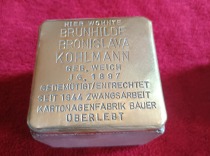
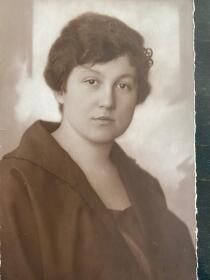
Brunhilde Kohlmann (1897–1984)
persecuted as ‘Jewish’
Stolperstein inscription:
HERE LIVED
BRUNHILDE
BRONISLAVA
KOHLMANN
NE. WEICH
BORN 1897
HUMILIATED / DEPRIVED OF RIGHTS
FORCED LABOUR SINCE 1944
BAUER CARDBOARD FACTORY
SURVIVED
-
© Privatfoto Familie Kohlmann
Bronislava, later Brunhilde Kohlmann, was born on 13 August 1897 in Lemberg (now Lviv), the daughter of master locksmith Alexander
(Aleksander) Weich and Minna, née Krebs. She was of the Jewish faith. After attending school in Lemberg for ten years, following the death of her mother – who died of a sarcoma at the age of 37 – she moved to Dresden, where she ran her grandmother’s household. In 1921, she was living at 20 Tetschener Straße, apparently as a lodger.
On 12 November 1921, she married Johannes Kohlmann. The couple had two children, Ursula and Alexander. Brunhilde may have converted to her husband’s Evangelical Lutheran faith even before the marriage; in any case, she was no longer a member of the Jewish faith later on. In 1922, her husband took over a practice in Großenhain, where she worked alongside him. After the family moved to Radebeul in 1932, she also worked at his private clinic at 16 Zinzendorfstraße.
There, she assisted in the operating theatre and was responsible for the clinic’s financial management.
The Kohlmann family was also affected by the anti-Semitic persecution carried out by the National Socialists. Brunhilde was forced to relinquish her role in managing the private clinic’s finances and, according to her own account, was no longer permitted to enter the clinic. In 1939, the NSDAP Lord Mayor Heinrich Severitt initially permitted her to use the first name ‘Zilla’ instead of ‘Bronislava’. This order was revoked in 1940. Instead, she was given the additional compulsory first name ‘Sara’, which stigmatised her as a Jew. From September 1940, she carried an identity card bearing the letter ‘J’ for ‘Jew’.
She was repeatedly subjected to denunciations and measures by the Secret State Police; she was also threatened with internment in a concentration camp. She was no longer permitted to use public transport. In 1944–45, she was forced to perform compulsory labour at the Bauer cardboard factory in Dresden and was assigned to the ‘Jewish department’.
According to her account, she was required to wear a yellow armband. She was exempt from wearing the ‘Jewish star’ due to her marriage to a man classified as ‘Aryan’ and her two children.
Following a decision by the Reich Security Main Office on 13 January 1945, all Jews capable of work and living in ‘mixed marriages’ were to be deported to Theresienstadt. Brunhilde also received a deportation order. Her deportation was scheduled for 16 February 1945, but did not take place as a result of the air raids on Dresden. She was therefore able to remain in Radebeul until the end of the war.
According to her own account, her father, her sister Julia Bodek and her sister’s children, Marion and Ralf, had already been murdered by the SS in Stanisławów (Poland) in 1942.
After 1945, Brunhilde Kohlmann once again took over the financial management of the private clinic and its kitchen. On 22 November 1947, she was recognised as a victim of fascism (OdF). Even after her husband’s death in 1949, she initially remained responsible for the financial management of the surgical clinic. In September 1949, however, her OdF status was revoked. The reason given was that she had neither been imprisoned nor had she worn the Jewish star, and, according to her own account, had merely been obliged to perform labour. As a result, she also lost the benefits associated with that status.
Kohlmann lodged an appeal and sought to have her status reinstated. In 1950, one of the criticisms levelled against her was that she was not politically active. In 1951, further enquiries were made into her Jewish heritage. As proof of her persecution, she presented her identity card, issued in 1940. On 27 June 1951, she was finally recognised once more as a victim of persecution and became a member of the VVN. At that time, she was still living at 16 Zinzendorfstraße and was listed as a housewife.
On 27 February 1953, she left the GDR together with her daughter Ursula and made her way to West Germany via West Berlin. Following her escape, the clinic on Zinzendorfstraße was nationalised and used as a branch of the local hospital or polyclinic. However, the Kohlmanns remained registered as the owners in the land register. The clinic’s inventory, including furniture, antiques and paintings, was partly handed over to museums and partly sold.
The experiences of persecution weighed heavily on Brunhilde Kohlmann. She hardly ever spoke about them and lived with her daughter for most of her life. On 6 July 1984, she died in Altbach near Stuttgart. She was given a church funeral.
Text: D. Ristau
-
© Daniel Ristau
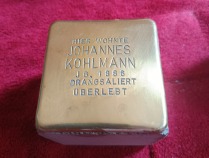
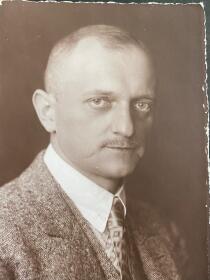
Johannes Kohlmann (1886–1949)
persecuted as having ‘Jewish relatives’ ( >> term "Jewish relatives")
Stolperstein inscription:
HERE LIVED
JOHANNES
KOHLMANN
B. 1886
PERSECUTED
SURVIVED
-
© Privatfoto Familie Kohlmann
Anton Johannes (Hans) Kohlmann was born on 26 July 1886 in Dresden. His father, the financial clerk Anton Ludwig Kohlmann (d.
1915), and his mother, Ida Rosalie, née Hofmann (1861–1940), were Evangelical Lutherans. The family initially lived at 19 Reisigerstraße. Kohlmann had four sisters, three of whom died young from rickets. His father rose to the rank of Under-Secretary of State for Finance and moved the family several times within Dresden.
Johannes Kohlmann studied medicine and was awarded a Doctor of Medicine degree on 9 May 1913 at the University of Leipzig. Little is known about his subsequent career. Apparently, he initially worked as a junior doctor at the Bethanien Deaconess and Hospital in Stettin. According to family tradition, he also worked for a time as a ship’s doctor, travelling to Asia amongst other places, which is said to have sparked his interest in Asian art. Furthermore, before returning to Dresden, he is said to have been a junior doctor to the renowned surgeon Ferdinand Sauerbruch.
By 1921 at the latest, Kohlmann was living in Dresden again, where he worked as a general practitioner. On 12 November 1921, he married Brunhilde Kohlmann, who was almost eleven years his junior. In 1922, he took over a medical practice at 10 Klostergasse in Großenhain, where the family moved.
In 1932, Johannes Kohlmann moved to Radebeul and opened a surgical practice at 16 Carolastraße (now Zinzendorfstraße). In 1938, he was able to purchase the building and was entered in the land register as the owner. During the Second World War, two Polish women were also employed in the house; according to the family, they were given a ‘warm welcome’.
The Nazi persecution of his wife and children also put Kohlmann himself under pressure. Among other things, he is said to have been urged to separate from Brunhilde. However, he stood by his wife, whose ‘Jewish’ origins were well known, and in doing so helped to ensure that she was spared some anti-Semitic measures. The strain apparently also took its toll on his health.
After his death, Brunhilde Kohlmann stated that he had suffered greatly from ‘constant emotional distress’, which had shortened his life. Indeed, he developed a pancreatic condition, severe diabetes and went blind towards the end of his life.
After the end of the war, numerous Red Army soldiers were treated at his clinic. He was reportedly even offered the post of mayor of Radebeul; for a time, he was also a member of the FDGB.
Johannes Kohlmann died on 1 September 1949 in Radebeul at the age of 63 and was buried in the local cemetery.
Text: D. Ristau
-
© Daniel Ristau
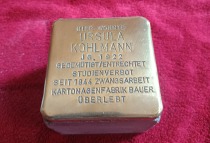
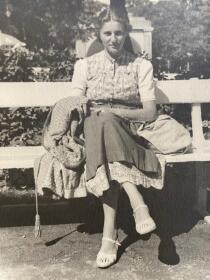
Ursula Kohlmann (1922–2000)
persecuted as a "first-degree Jewish mixed-race person"
Stolperstein inscription:
HERE LIVED
URSULA
KOHLMANN
BORN 1922
HUMILIATED / DEPRIVED OF HER RIGHTS
BANNED FROM STUDYING
FORCED LABOUR SINCE 1944
BAUER CARDBOARD FACTORY
SURVIVED
-
© Privatfoto Familie Kohlmann
Ursula Kohlmann was born on 18 July 1922 in Dresden. After spending her early school years in Großenhain, she moved with her family to Radebeul in 1932, to 16 Carolastraße (now Zinzendorfstraße).
As a schoolgirl and a ‘first-degree Jewish mixed-race person’, she was subjected to anti-Semitic hostility. Nevertheless, she continued her education and presumably obtained her Abitur in Dresden. She was denied the opportunity to study during the Nazi era. She then probably helped out at her father’s clinic and, like her mother, was conscripted in 1944–45 for forced labour at the Bauer cardboard factory in Dresden. She was in Radebeul when the war ended.
After 1945, she studied medicine in Jena and was awarded a Doctor of Medicine degree there on 2 February 1953. She then worked initially at the Dresden-Johannstadt Hospital. When she refused to be conscripted to work on a Kriegsmarine construction site in Binz on Rügen, she was threatened, amongst other things, with the withdrawal of her planned full medical licence. Consequently, on 27 February 1953, she fled to West Germany via West Berlin together with her mother.
In Baden-Württemberg, Ursula Kohlmann successfully began practising medicine. It is said that for a time she was the first female chief physician there, but she had her rank downgraded to senior consultant so that she could continue to work directly with patients. For a while, she also worked as a doctor in Zurich.
Ursula Kohlmann never married and had no children. She lived with her mother for a time. Together with her brother, she later witnessed the fall of the Berlin Wall and campaigned for the villa at 16 Zinzendorfstraße in Radebeul and its contents to be returned to the family.
Ursula Kohlmann died on 1 January 2000 in Stuttgart.
Text: D. Ristau
-
© Daniel Ristau
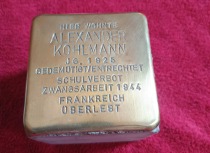
Alexander Kohlmann (1925–1996)
persecuted as a "first-degree mixed-race Jew"
Stolperstein inscription:
HERE LIVED
ALEXANDER
KOHLMANN
BORN 1925
HUMILIATED / DEPRIVED OF HIS RIGHTS
BARRED FROM SCHOOL
FORCED LABOUR 1944
FRANCE
SURVIVED
-
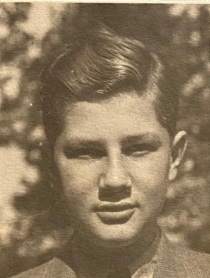
© Privatfoto Familie Kohlmann
Hans Alexander Kohlmann was born on 19 April 1925 in Großenhain and moved with his family to Radebeul in 1932, where he attended the local primary school. As a ‘first-degree Jewish mixed-race person’, he was initially spared some anti-Semitic measures, but came under increasing pressure from persecution. From 1939 to 1941, he attended the private boarding school Institut auf dem Rosenberg in St. Gallen (Switzerland).
After his return, he attended Curt Laue’s preparatory college in Dresden and passed his secondary school examinations in early 1943. He was denied the opportunity to study due to Nazi persecution.
In 1942, Kohlmann was assessed as fit for military service but was not conscripted into the Reich Labour Service. From April 1944, he was forced to perform hard labour for Organisation Todt. Following the Allied landings in Normandy, he was conscripted into the Wehrmacht in June 1944 and was taken prisoner by the US forces shortly afterwards. At the Joseph T. Robinson Prisoner of War Camp in Arkansas, he completed an English language course at the end of 1945.
After his release, Kohlmann returned to the Soviet Occupation Zone and was discharged to Radebeul in April 1946. In 1947, he began studying medicine at the Friedrich Schiller University of Jena, graduating in 1952. In the same year, he was recognised as a victim of fascism.
On 27 February 1953, Kohlmann left the GDR together with his mother and sister. After being recognised as a refugee, he resettled in the Federal Republic of Germany. In 1955, he obtained his doctorate at the University of Frankfurt am Main. After holding several posts as a junior doctor, he set up his own radiology practice in Frankfurt in 1962, which he closed in 1990.
In 1957, Kohlmann married Johanna, née Hampel (1931–2023); the couple had two children. After the fall of the Berlin Wall, he and his sister witnessed the return of the villa at 16 Zinzendorfstraße in Radebeul, along with its contents, to the family. The photographs he had taken of the works of art and antiques before fleeing had facilitated the restitution. Alexander Kohlmann died on 2 April 1996 in Frankfurt am Main.
Text: D. Ristau