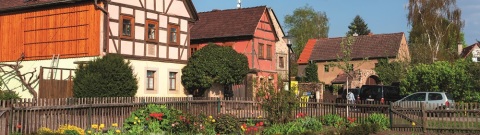
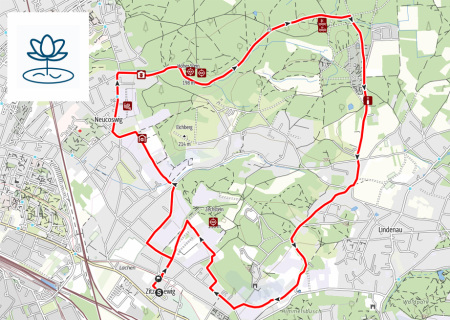
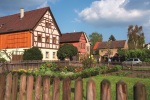
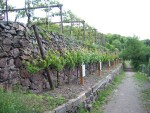
The tour starts at the historic Zitzschewig village green. Here you will find a listening station of Radebeul's history and a pretty playground. From here, the route heads towards Gerhart-Hauptmann-Straße. Above Mittlere Bergstraße, between Krapenbergweg and Kynastweg, is the Krapenberg. It was demonstrably used as a vineyard from 1590. On the right-hand side of the Krapenberg stands the Krapenburg, which was built in 1710 and rebuilt and renovated in 1988. Following its renovation, it has been restored to its former beauty. Along the Mittlere Bergstraße and the Kynastweg, behind the long 2.5 to 3 metre high natural stone wall, is the former vine testing station and an almost completely preserved Talut plant measuring approx. 40 x 70 metres. This facility was built in 1862 by Leipzig pharmacist Ludwig August Neubert for the weather-protected cultivation of table grapes and cold-sensitive fruit crops. The talut walls were intended to store the sun's heat and thus create a microclimate that was more favourable for table grapes.
Continuing uphill along the Kynastweg, you reach the former "Haus Kynast" winery, a baroque vineyard complex in Zitzschewig. The impressive estate consists of the manor house with a high hipped roof (built in 1760), the tower house, the gardener's house, stables and the barn. The latter three buildings have been lovingly restored and are now used for private residential purposes. A wide driveway leads into a park-like garden with beautiful old trees, including one of Radebeul's oldest protected sweet chestnut trees.
The Kynastweg ends at the entrance to the Rietzschkegrund, where you turn left onto the Talkenbergweg. There are cultivated vineyards on both sides of the path. Before you reach Spitzgrundstraße from Talkenbergweg, you will see the "Talkenberger Hof", a renovated former winegrower's house with outbuildings, on the right-hand side. Walking along Spitzgrundstraße, you will come to the forked path on the right.
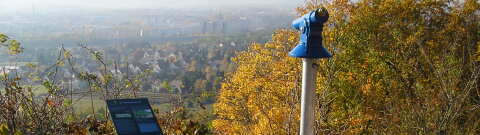
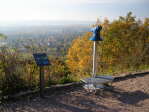
Before climbing the steps to the "Hohen Stein", you walk past the springs of the Pfarrbach stream. The spring water is collected by a spring catchment and channelled into the stream. Once you have mastered the ascent to the "Hohen Stein", you can find out more about the history, nature and landscape on various information boards and enjoy the view over the valley. After the descent, you return to the forked path and continue towards the water lily pond.
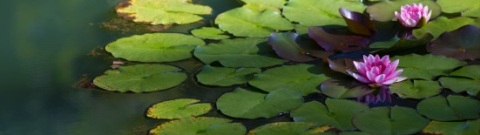
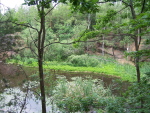
The lake is located on one of the three Spitzgrund forest nature trails. It was formed at the end of the 19th century in a syenite quarry through the accumulation of rainwater. There are no natural inlets or outlets and the water level depends on the amount of precipitation and surface evaporation. The structure of the ecosystem of the water lily pond is shown in biotopes on a panel. The lake got its name from the widespread distribution of the white water lily. When the water lily is in bloom, the lake is a marvellous sight.
Continue along the Kreyernweg, which you leave at a fork to follow the Auerweg. Later, turn left into the Kroatengrund and head downhill. The lower part of this path is surrounded by high vineyard walls, and it is also worth taking a look towards the vineyards here.
Continue along the Knollenweg to the Mittlere Bergstraße. To the left is the small chapel of St John. The path continues to the right along Hohenhausweg to Zechsteinweg. There is an educational wine trail here, which provides information about the different grape varieties in the Elbe Valley. The Langenbergweg takes you back to your starting point.
At the end of the path, you come to Obere Johannisbergstraße, which takes you directly to the tram stop of the same name on tram line 4, where you can continue in the direction of Dresden or Weinböhla.
Perhaps you would like to take a short detour to our "Schloss Wackerbarth" adventure winery?
Then simply turn left from Obere Johannisbergstraße into Mittlere Bergstraße and after approx. 100 metres you will have reached the baroque castle complex of Count von Wackerbarth. Today, the state winery is home to one of the most modern facilities for sparkling wine and wine production. So if you would like to know why sparkling wine is shaken and not shaken, take part in one of the wine or sparkling wine tasting tours.
Worth seeing and experiencing
- Quarry at Himmelsbusch
- Zechstein viewpoint
- Wine nature trail
- Zitszchewig historic village green
- Water lily pond
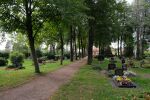
- St John's Church & Cemetery
- Bishop's press
Navigation & Tracking