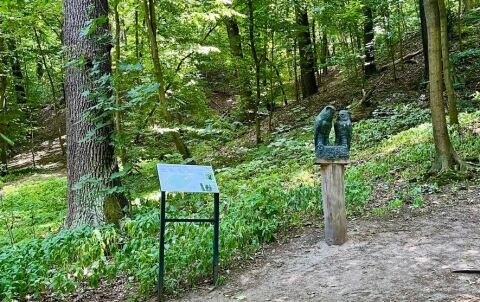
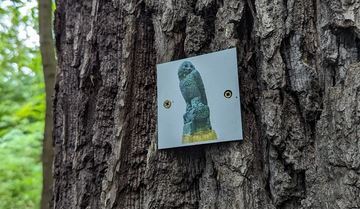
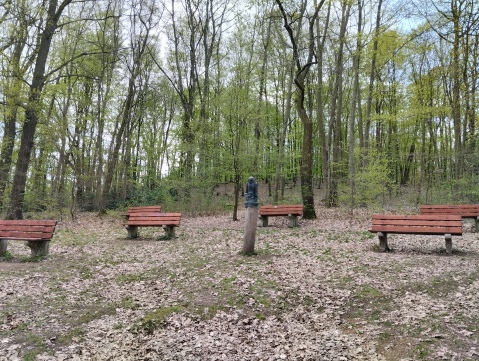
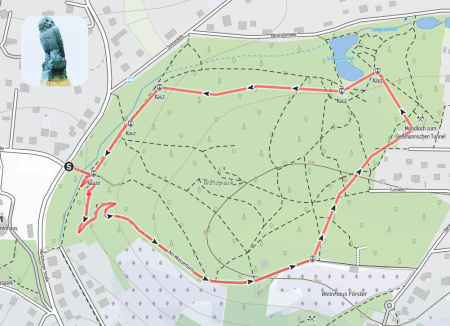
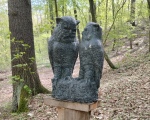
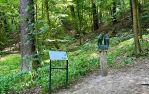
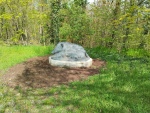
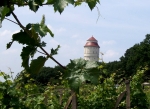
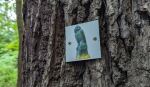
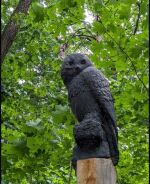
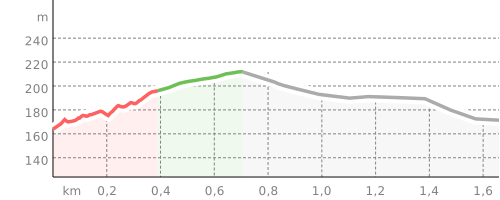
The Käuzchenweg starts at the junction of Moritzburger Straße and Kottenleite. From here, a few steps lead down to the historic forest park. The first two owl sculptures greet you here, and a plaque provides information about the trail, the history of the forest park and the artist who created the owls. A short climb leads up towards Wassertum. Here it is worth taking a look over the vineyard wall into the Elbe valley. The path continues to the mouth of the Gießmann tunnel and turns left from here towards Schwarzes Teich. Here, too, there are information boards with interesting audio tracks. From here, the trail heads back towards the starting point.
The forest park
Ludwig Pilgrim, owner of the Mohrenhaus, had the park-like "Pilgrimswäldchen", named after him, laid out as early as 1850. Towards the end of the 19th century, this was further developed and upgraded by the "Verschönerungsverein für die Lößnitz" by laying out new paths and installing benches.
The increasing expansion of the nearby Bilzbad, whose fencing off by the authorities was seen by some as an imposition, prompted the Niederlößnitz local councillor Richard Sachse to strongly advocate the establishment of a public public park and recreation area in this area from 1907. The donation of a 3.2 hectare forest plot by the forester and royal chamberlain Hans Friedrich Bernhard von Minckwitz (1849-1929) as well as donations from well-known Niederlößnitz citizens made it possible to establish a forest park foundation in 1910. It was chaired by the municipal council of Niederlößnitz and later by the mayors of Kötzschenbroda and Radebeul. The declared aim of the foundation was to "protect the natural beauty of the landscape from the ruthlessness of modern development".
With the support of associations and the neighbouring communities, the foundation ensured the further construction and maintenance of paths, steps and shelters. It also developed the area around Schwarzes Teich and endeavoured to restore and preserve the natural vegetation in the park area, which was expanded to almost 20 hectares through acquisitions and usage agreements. After the Second World War and the winding up of the foundation in 1949, the area was managed by the state forestry enterprise. From 1971, part of the former park area was developed into the "Schwarzes Teich" recreational area. Today, the forest park is part of the Lößnitz landscape conservation area.
Ulrich Eißner
The artist and creator of the "Käuzchen" was born in Karl-Marx-Stadt in 1962. He works as a lyricist, pianist, theatre sculptor, draughtsman, graphic artist and academic sculptor and lives in Dresden. Eißner works there as a professor at the Academy of Fine Arts (HfBK). He is a very creative artist and masters a wide variety of modelling techniques. He works with terracotta, plaster, bronze, wax, porcelain, wood, stone and concrete. His works are like stagings and are thought-provoking.
The little owls he has created accompany visitors through the Radebeul-West forest park and mark an attractive circular route with many highlights along the way.
Worth seeing and experiencing
- Sculptures of owls
- Black pond
- Water tower
- Viewpoint
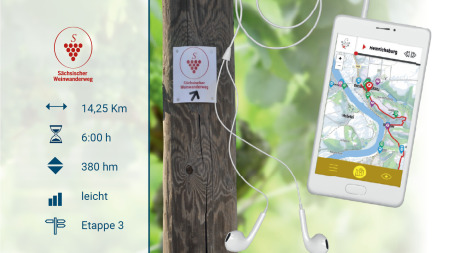
Navigation & Tracking