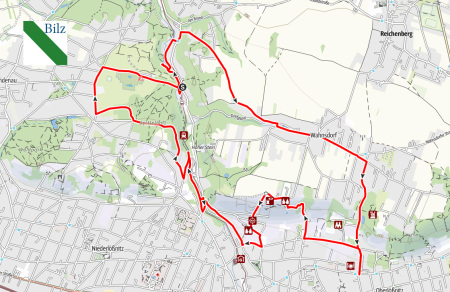
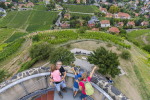
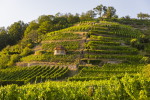
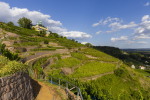
The Bilzweg stretches over ten kilometres and takes around three hours to walk. It covers a difference in altitude of 287 metres and is marked throughout with the green "Bilzweg" sign. What characterises this trail is its great variety of landscapes: it leads through forests, past quiet ponds, through the deeply incised Lößnitzgrund and up to the Lößnitz vineyards with their sweeping views of the Elbe Valley.
The starting and finishing point of the circular route is Eduard-Bilz-Platz in Oberlößnitz. Inaugurated by the Bilzbund in 2002 and redesigned in 2017, the ornamental square with its water feature and drinking fountain marks the intersection of Eduard-Bilz-Straße and Augustusweg . From here, the route first leads towards Hoflößnitz - the former electoral vineyard and today's Museum of Saxon Wine History.
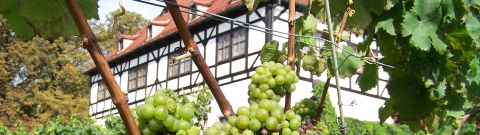
From here, the route continues along Eduard-Bilz-Straße and past the former Bilz-Naturheilanstalt (house numbers 53-57), which Bilz developed into one of the largest natural healing centres of its kind from 1890. Via Weinbergstraße, you reach the Bennoschlößchen, the oldest preserved manor house in Lößnitz dating back to 1570. The route continues through the vineyards - past historic winegrowers' houses from the 17th century - via Weberstraße and Eggersweg up to the Spitzhaus.
The Spitzhaus is one of the scenic highlights of the tour. The view of the Elbe valley from here is breathtaking - the valley lies at your feet, the vineyards stagger downwards in terraces. Right next to it is the Bismarck Tower, from whose plateau the view is also worthwhile. The legendary Spitzhaustreppe staircase with its many steps takes you back down into the valley to the Hoflößnitz, the mountain and pleasure house built by Elector Johann Georg I from 1649. Here, the winery invites you to take a break with a glass of Saxon wine. The trail leads into the Lößnitzgrund via Weinbergstraße and Lößnitzgrundstraße.
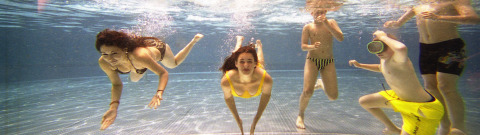
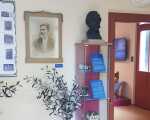
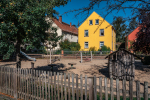
Here, the trail is accompanied by the Lößnitzgrundbahn, the famous narrow-gauge railway that has been steaming through the valley since 1884 and is affectionately called the "Lößnitz Dachshund" by the locals. At the "Hoher Stein" quarry, the trail turns westwards, up to the hunting trail and onwards "Am Spittelholz" to the Buchholzweg. The wooded section offers close-to-nature experiences. At Buchholzweg, the path turns northwards to Meiereiweg. The Bilzbad is located here. The Bilzbund has put together a small collection about Eduard Bilz in the former gatekeeper's cottage. This can be viewed on request. Via Meiereiweg, the path leads back into the Lößnitzgrund, past small ponds and always along the Lößnitzbach stream. From the Lößnitzgrundstraße, the path continues eastwards. The Unterer Langenwiesenweg takes you to the historic Altwahnsdorf village green. Children will love the idyllic playground here. Thirsty hikers can enjoy a glass of Radebeul wine at the ZiegenWein wine tavern, which also offers delicious cheese products. Via the Graue Presse Weg and the Straken, you return to the starting point at Eduard Bilz-Platz.
Information on site
QR codes on the signposts at various stations provide information about the eventful life and work of the naturopath and life reformer
They tell of his beginnings in the colonial goods shop, of his friendship with Karl May, with whom Bilz shares his final resting place in the Radebeul-Ost cemetery, and of the bold utopia of his science fiction novel "In a Hundred Years", in which he sketched out his vision of a natural state. The picture trail makes this multi-layered story tangible on site - as an invitation to discover the principles of a natural way of life for yourself.
Friedrich Eduard Bilz
Friedrich Eduard Bilz, born on 12 June 1842 in Arnsdorf, came to the key realisation that a consistently healthy lifestyle not only alleviates illness, but actively prevents it, after overcoming severe health crises himself. As a young journeyman weaver, he suffered from the miserable working conditions of industrialisation - 14 hours a day in closed rooms, plus artificial light and a lack of exercise - which led to stomach cramps and a serious lung condition. These experiences shaped his life and led him to become an autodidact in naturopathy.
His main work "Das neue Naturheilverfahren" (The New Natural Healing Method), affectionately known as the Bilz book, became a bestseller. The encyclopaedia with simple, vivid explanations of medical facts sold millions of copies - by 1938, around 3.5 million copies had been distributed in twelve languages. From 1905, Bilz used the considerable proceeds to create a light and air bath in Radebeul, a public health centre that was also intended to be accessible to the general public. The facility initially comprised 50 air bathing cells, several water basins and later one of the first wave machines in Germany - an Undosa wave machine presented at the International Hygiene Exhibition in Dresden in 1911, which Bilz purchased immediately and had installed in 1912. This oldest still-operating wave machine of its type is now a technical monument and can still be used today. He also developed and produced "reform foods" such as Bilz nutritional salt, nutritional salt cocoa and malt coffee as well as the non-alcoholic Bilz fizzy drink, which was created together with drinks specialist Franz Hartmann and is now known worldwide under the name Sinalco.
Worth seeing and experiencing
- Information boards about Eduard Bilz with QR codes
- Albrechtshöhe viewpoint
- Bismarck Tower viewpoint
- Spitzhaus & Spitzhaustreppe (with audio guide & viewpoint)
- Hoflößnitz Vineyard Museum (with playground, herb garden, sttaion of the bee trail & audio guides)
- Wine taverns & wineries
- Bilz-Bath
- Bilz Museum
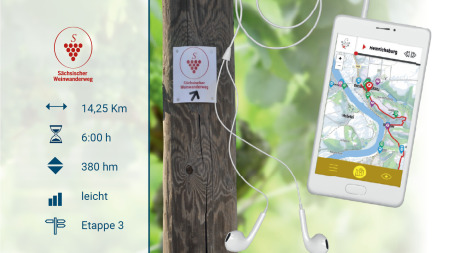
Navigation & Tracking