1. Kopf
  2. Navigation
  3. Unternavigation
  4. Inhalt
  5. Fuß
Kopf
Radebeul Homepage

Language: Deutsch | English

Legal note | Sitemap
Navigation Unternavigation
 
You are here: Homepage / Tourism & Culture / The Town / Radebeul - a historical guide
Inhalt

Radebeul - a historical guide

On April 1st, 1924 Radebeul received its town charter, making it a relatively young town.


Farmhouse around 1920

The development of the original settlement began many centuries earlier, however. The current municipal area of the town encompasses 10 previously independent communities. The parish of Radebeul, which lent the town its name, was a very small and unimposing hamlet comprising 12 farms (today this area is known as
Alt-Radebeul-Am Kreis in the center of the town), which was first documented in 1349.


Kötzschenbroda: Main Street and village center, 1900

The largest settlement in the Lößnitz region was Kötzschenbroda with 60 farmsteads, which first appeared in written records in 1271. On 08/27/1645 a ceasefire was signed between Sweden and Saxony prior to the Peace of Westphalia. Altkötzschenbroda's flair is apparent to all who visit its annual Fall and Wine Festival.


Radebeul - Naundorf

The earliest record of the existence of a Lößnitz settlement is from 1144. Naundorf is thus mentioned earlier than Dresden. The town center can still be experienced in its complete original state. Especially during the Village and School festival that takes place every two years, the old wine cellars beckon you to sample some of their Saxon wine.


Zitzschewig: village center and monument

Zitzschewig is located very close to Naundorf. In the First World War this place name is said to have been regularly used as a password as it was rather difficult for the English or the French to pronounce.


Lindenau: Entrance to Birkes farmhouse, 1909

Lindenau is the second smallest part of the town; its main inhabitants were primarily winegrowing families who earned their humble living in the neighboring vineyards. The village was renowned for being home to a large number of children, as they made up 25 of the 100 inhabitants. It will not come as a surprise to anyone, therefore, that when the parishes were united nobody was prepared to bear the high costs of schooling.


Serkowitz: Old restaurant Serkowitz 1920

The nearest parish to Radebeul is Serkowitz, situated on the banks of the Elbe. On the 18th October 1784 a hunting party led by Elector Frederick Augustus was traveling along the old Meissen postal road and country highway that had been washed away by the Elbe (today this road is known as Kötzschenbrodaer Straße). There would almost certainly have been an accident if two farmers' wives had not warned the party of the danger.


Wahnsdorf: Partial view with pond, restaurant und „Strakenweg" 1915

Situated somewhat apart on the elevated plains is Wahnsdorf, particularly renowned for its meteorological observatory. There is also an interesting historical building on Wahnsdorf plain, the former Bilz sanatorium.
This smallest of communities came into being in 1550, completely enclosed as it was on the Kötzschenbroda plain, on the site of the Elector's former outwork, and it was therefore given the name Fürstenhain. This hamlet of 8 houses only existed for a short period of time. It was incorporated into Kötzschenbroda as early as 1876. Fürstenhainer Straße is the only reminder of this hamlet.

The emergence of two new Lößnitz parishes on the plains of the existing villages is another special feature of Radebeul

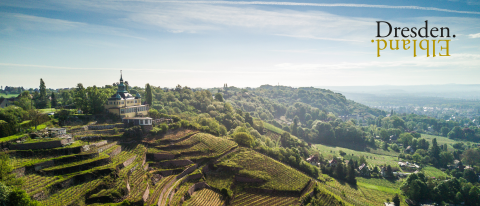
This development was shaped in the main by the characteristic landscape of the Lößnitz, the vineyards. They greet visitors from afar, giving guests the feeling of being in more southern, Mediterranean climes. It is for this reason that Radebeul has also more recently come to be known as the "Saxon Nice".


Hoflössnitz

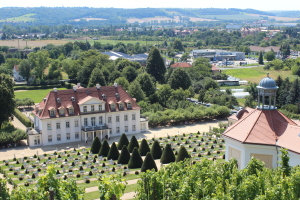
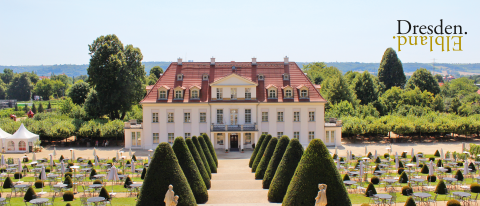
The farmers' vineyards were located far away from the actual town centers. In the 16th/17th century the vineyards changed hands at an ever increasing rate. Aristocrats and the well-heeled citizens of nearby Dresden, in particular, took great pleasure in producing their own wine and serving it to their guests. This took place to a greater extent following the end of the 30-year war, beginning with the building of the Hoflößnitz country estate by the Elector of Saxony in the year 1650.


Oberlößnitz: View to the Spitzhaus around 1935

More stately homes began to emerge that served as summer residences for the new vineyard owners. These elegant villas are protected as historical monuments today, and following German reunification they have been lovingly restored by their owners. The owners of the villas spent the winter in their town houses. Perhaps one or the other remained in the Lößnitz region throughout the winter, too, to facilitate the development of the new colonies of villas which would eventually become permanent residences. The owners continued to pay their taxes in their main place of residence. This led to recurring disagreements with the local farmers. The villages' financial burdens continued to rise. The poor had to be provided for, night watchmen expected their salaries, and schools had to be built and maintained, as the population continued to increase apace. A temporary solution was created in Oberlößnitz in 1822 by the formation of a "Municipal Association of Vineyard Owners", and in Niederlößnitz by the formation of the "Niederlößnitz Vineyard Association" in 1832. The new rural community law of 1838 brought this unusual situation to an end. The two associations were more or less compelled as of 01/01/1839 to observe all rights and responsibilities of a genuine municipality. And so 8 Lößnitz settlements became 10. Oberlößnitz and Niederlößnitz came into being - another feature of Radebeul.


Radebeul: View to city hall and old post office around 1918

50 years later there was talk of unifying the Lößnitz parishes. The sharp rise in the numbers of residents and other economic necessities were the reasons behind it. This development gained momentum at the beginning of the 20th century when Dresden began to incorporate many, previously independent adjoining settlements into its boundaries. The Lößnitz settlements were spared this fate with the merger of the two towns of Radebeul and Kötzschenbroda in 1935, after Eastern and Western Lößnitz towns had already commenced the process of unification in stages. This step proved to be a clever political move for the continued development of the town, as Radebeul was named "County town" in 1995, and was thus spared from being incorporated into the city of Dresden.

That was a brief introduction to the early history of the town of Radebeul, a town which does not reflect the typical image of a town with a church and a market place, but one which is all the more attractive for its diversity. Even today the inhabitants of Radebeul still take great pride in their distinctive districts. What's more, festivals and celebrations to mark the founding of the different districts testify to the fact that these local historical traditions have not been forgotten, and that they continue to be maintained.

Fuß