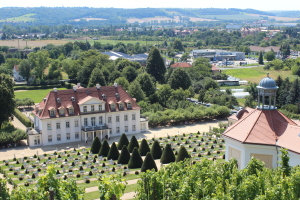
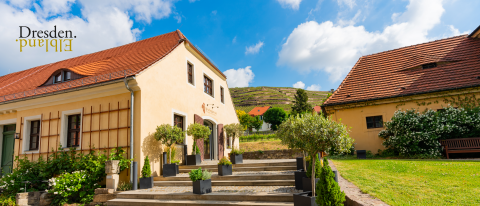
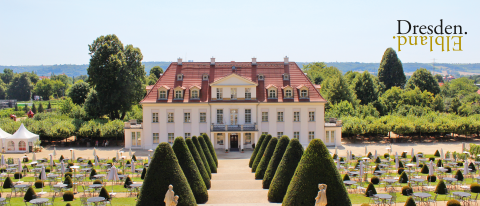
From the "Zinzendorfstraße" tram stop (Line 4), or from the S1 suburban railway stop at Radebeul-Ost walk along Zinzendorfstraße, cross Meißner Straße and then continue along August-Bebel-Straße. At the end of August-Bebel-Straße turn left into Augustusweg and then right onto Eduard-Bilz-Straße. Haus Albertsberg is the crowning glory of the newly built residential area "Am Albertsberg." Haus Albertsberg is a stately home protected as a historical monument, which is recorded as having been used as a residence constructed of stone with a wine press as early as 1660. The house was given its current neo-baroque character with tendencies towards the Jugendstil following renovation in 1898. Restoration of the manor house began in 2005.
Passing Haus Albertsberg you will come to the former Bilz sanatorium on the right. This was named after Friedrich Eduard Bilz, a well-known naturopath. Bilz converted the washhouse into a bath house, and the cow shed into gentlemen's baths, and in September 1892 he obtained permission to run a sanatorium. Due to great demand he had a four-story Swiss-styled spa hotel built from designs by the Ziller brothers. After a varied history the sanatorium was extensively renovated in 2007 and is now a residential property.
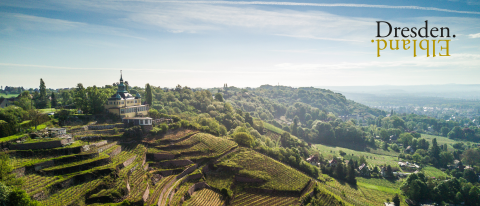
Following the road marked Straken past the Bilz sanatorium you will see the "House in the Sun" to your left, set amidst the vineyards. The house is a two-story, 1770 baroque wine estate. It was built as a country house for the electoral Saxon financier Georg Christian Staedter. Continuing along "Straken" you will discover some well-maintained vineyard walls on your left, which have become noticeably wooded. At the top of the hill turn left into Hohlweg and follow this downhill. On your way into the valley you will pass the back of the "House in the Sun" before the path gets narrower and more enclosed by the vineyard walls.
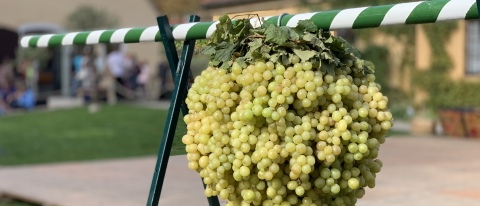
Shortly before the path comes to an end please turn to admire the Balberg Mountain, on top of which the "Stone snail" is enthroned. It emerged in the early 17th century from syenite stone and is unparalleled in Germany. Continue on your way by turning right onto Weinbergstraße. You are now standing directly at the gates of the "DREI HERREN" winery, the core of which has been in existence since 1714. Due to severe dilapidation the building was carefully restored between 1993 and 2005 by Wolfgang Richter and the art historian Dr. Rainer Beck, and the "DREI HERREN" winery was founded. Perhaps you might like to try a drop of Radebeul wine with the knowledgeable guidance of the 2003 Saxon wine queen.
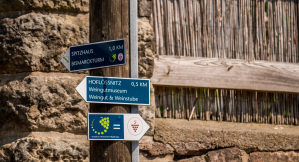
Continue along Weinbergstraße until you come to "Haus Lorenz." This house was built in the 17th century. Today it is used only for residential purposes. As you continue along the idyllic Weinbergstraße you will come to the Retzschgut estate which was renovated at great cost in 2006. The estate includes a large vineyard where grapes have been cultivated since 1649. The manor was named after the painter and professor of the Dresden Academy of Art, Moritz Retzsch, made famous in part by his illustrations of Goethe's "Faust." The current owner still maintains the vineyard, and in 1992 he founded his own winemaking business. His seasonal wine tavern serves wines cellared on the premises. At the junction of Weinbergstraße and the corner of Hoflößnitzstraße you will see the Meinholdsche Turmhaus (tower house) to the right. The tower house is an estate that has been cultivated and farmed since the 16th century. The Meinhold family gave the country manor the stamp of their personal style for 100 years, and in so doing they created a counterpart to Hoflößnitz Winery Museum. Today the historic winegrowing estate is known by the Aust vineyard name. Friedrich Aust continues the tradition and has put life back into the old winery.
Please turn left into Hoflößnitzstraße and left again into Bennostraße at the next junction. If you continue along Bennostraße you will discover many of the small residential houses and winegrower's inns which are typical of the region. At the end of Bennostraße you will see Benno Manor on the left. It is the oldest, manor house in the Lößnitz that is still largely in its original condition. It was built before 1580 as a vineyard tower house. However, the house was not given the name of the legendary patron saint, the canonized Bishop Benno, until the Romantic period. The picturesque Renaissance style roof structures on the north and south of the building are particularly striking.
Follow Bennostraße as it turns gently to the right until you come to Augustusweg on the left, which you should follow.
After a few meters you will come to the "Haus Sorgenfrei" or "No Worries House," one of the most architecturally important manors in the Lößnitz. This two-story manor built in 1783 is considered to be the last remaining example of a building in the so-called "Dresden late rococo style." The building complex was extensively renovated in 1995 and today it houses a hotel.
Continuing along Augustusweg turn right at a small circular flower bed onto Eduard-Bilz-Straße. In this section of the street you will find a number of buildings in the same style, the so-called "Ziller" houses. These houses were designed and built by the Ziller brothers, master-builders who lived in Radebeul.
At the end of Eduard-Bilz-Straße turn left onto Meißner Straße where you have the option of taking the tram (Line 4) in the direction of Dresden or Weinböhla.
Distance: approx. 5 km
Duration: 2 h
Difference in elevation: 100 m
Level of difficulty: Medium