




Cycling concept
Two years after the adoption of the cycling concept, the first Radebeul cycling conference focussed on the following questions: What has been achieved? What is in preparation? What has priority? Oliver Lange, Head of the Civil Engineering Office, Ingolf Zill, Head of the Traffic Department, and Dr Michael Steinbusch from the Urban Development Office welcomed the 28 participants in the Council Chamber on the evening of 29 October 2024, along with Radebeul citizens, members of the City Council and the ADFC. The event was moderated by Frank Kutzner, Managing Director of wegebund Sachsen, the working group of Saxon municipalities for the promotion of cycling and walking.
Among the measures already implemented, the administration's presentation particularly emphasised the bicycle shed on Güterhofstraße, the opening of Wilhelm-Eichler-Straße in the opposite direction, the fundamental expansion of the cycle and footpath at Wackerbarth Castle and the improved classification of cycle traffic during the expansion of Meißner Straße. The construction of a cycle parking facility at the Zitzschewig S-Bahn stop is planned for 2025.
The planning of a cycle path connection in Waldpark as an alternative to Moritzburger Straße will be continued in the coming year with an evaluation of the comments and objections from citizens. Pestalozzistraße between Steinbachstraße and Schildenstraße and Maxim-Gorki-Straße between Alvslebenplatz and August-Bebel-Straße are to be thoroughly upgraded and then designated as a cycle route between 2025 and 2026. A corresponding feasibility study will be carried out for Winzerstraße between Am Jacobstein and Heinrich-Zille-Straße in 2025. The slip road to Niederwarthaer Brücke is to be made cycle-friendly in the same period.
The planning of a cycle lane in Uferstraße and An der Festwiese, which was intended to implement a measure from the 2022 cycling concept and the 2018 action plan (transport development plan), was not pursued further due to justified objections from local residents. In its place, the specialist administration will soon present a modified plan that responds to the various problems along this route with a bundle of different measures in two expansion stages. The first stage is to be implemented in 2025.
The framework plan for a sports and cultural centre in Radebeul will be presented to the public on 10 December 2024. You can read more about this in an article in this official gazette. The framework plan envisages the creation of a new cycle and pedestrian connection from Bernhard-Voß-Straße to Steinbachstraße. The Weintraubenstraße near the railway is to be crossed without an intersection using a bridge structure to enable cyclists and pedestrians to cross the busy road safely and to avoid holding up north-south traffic with an additional traffic light system.
In the coming years, future additions to the network in the form of a major expansion, such as on Lachenweg, or an expansion as a cycle lane, such as on Gradsteg and Nizzastrasse, should gradually complete the network of safe and easy-to-use cycle routes off the main roads envisaged in the cycle traffic concept.
In the discussion, the planned improvements and additions to the network were largely met with approval, although changes to the route were suggested and alternatives to individual solutions were put forward. Not everyone was convinced by the costly bridge solution on Weintraubenstraße, for example, and the idea of creating a connection between Richard-Wagner-Straße and Roseggerstraße to the north of the youth hostel, which would lead over a traffic light at Weintraubenstraße, was put forward. The administration promised to take this solution into account in a traffic report.
The criticism was that far-reaching plans were presented, but too few tangible results. Numerous known problem areas in the city had not yet been eliminated, and there was also a lack of a time perspective as to which measures should be prioritised in the future. Greater consideration was demanded for cycling at roadworks. Sections of the cycle network in need of improvement, such as the one between Gradsteg and Gottesacker, were also pointed out. With regard to participation in planning in the forest park, it was not clear whether only individual comments should be made or whether there should also be broader coordination, which would be desirable. Mr Kutzner suggested that councillors should be approached more frequently with demands and suggestions regarding cycling.
-
© Stadtverwaltung Radebeul
Radverkehrskonzept Veranstaltung Dezember 2022
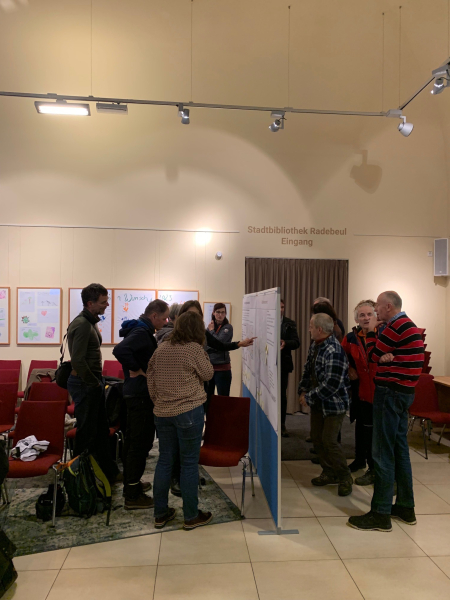
December 2022: Public information event on 8 December 2022
On 8 December 2022, the public was informed about the cycling concept at an event in the Kultur-Bahnhof. The Hannover-based office Planungsgemeinschaft Verkehr (Ms Prahlow, Ms Schröder) presented the concept together with the Office for Urban Development (Dr Steinbusch) and the Civil Engineering Department (Mr Lange, Mr Grundmann). Central contents are presented on posters and put up for discussion.
The event was well attended and interest appeared to be high. Overall, there was a certain dissatisfaction with the promotion of cycling in Radebeul. Problems that were discussed years ago have still not been resolved. Communication during the development and publicising of the concept was also criticised as inadequate and the measures as not far-reaching enough.
In the discussion, the following topics were repeated and emphasised by citizens:
- Urgent improvements were demanded for
- school cycle traffic , with examples given of the routes to school from Luisenstift and Lößnitzgymnasium (with both locations), the route to the KrokoFit indoor swimming pool, the Maxim-Gorki-Straße/Nizzastraße road with damaged pavement, many parked cars and inconsiderate behaviour by motorists, and the same on Winzerstraße. Corresponding measures have already been named in the cycle traffic concept.
- Rapid implementation was called for. In
- connection with school cycle traffic, but also in general, there were calls for cycle lanes. The Uferstraße/An der Festwiese pilot project is not the most urgent due to its lack of relevance for schoolchildren and commuters.
- In connection with cycle lanes, the administration refers to the aim of the cycle traffic concept to create alternatives to Meißner Straße. The
- expansion of Meißner Straße lacks continuity in the routing of cycle traffic.
- In addition, there are bottlenecks at the tram stops. A
- lack of representation of routes beyond the municipal boundary was criticised, especially commuter routes. The
- sense and nonsense of hard shoulders was debated. They only fulfil their purpose if the recommended width is actually adhered to.
Many other suggestions, problems and topics were addressed and taken up just as carefully by the administration. Citizens can contact the city administration, Dr Michael Steinbusch, Urban Development Office, Tel. 8311-956, at any time with their concerns and comments on cycling.
September 2022: Political consultations and vote
The city of Radebeul now has a cycling concept, which was unanimously approved by the city council at its meeting on 21 September 2022. The concept will serve as a basis for decision-making in politics and administration in the future. It is intended to better integrate cycling into transport and investment planning. Last but not least, a cycling concept is needed in order to be able to apply for certain subsidies. The Hanover-based transport planning consortium drew up the concept in close consultation with the Radebeul administration and discussed it with many citizens. The professional view of the transport planners from outside was combined with the local knowledge of the residents.
Looking at the city as a whole
What is new is that cycling is being considered across the entire city of Radebeul and beyond its borders. As with other modes of transport, isolated measures do not lead to success when it comes to cycling. It depends on the quality of the connections, which is why the focus is on the city as a whole. Increasingly, people want to get from A to B safely, comfortably and effectively by bike. The distances travelled each day have become longer, partly due to the spread of e-bikes. Commuter connections are being discussed, which used to only be an issue for cars and trains. For the cycle traffic concept, it was first necessary to determine which source and destination areas are particularly important and how best to connect them. In addition to residential areas as sources, destinations include, for example, schools, workplaces, retail outlets, but also suburban railway stations where you can change from bike to train. This raises the question: Where to go by bike? Can I charge my e-bike during this time? The cycle traffic concept has analysed the entire city area with these and other questions in mind and linked the results to form a "network". From a transport planning perspective, this is nothing new and is actually a matter of course - it's just that this comprehensive view of cycling has not yet existed. Much of this network already exists and works well. Others would have to be relocated, linked, repaired or created from scratch.
Promoting cycling
In addition to meeting demand, the city also wants to explicitly promote cycling and do more than is absolutely necessary. The aim is to motivate even more people to switch to cycling for certain routes by providing attractive connections. Cycling is good for your health and avoids noise and exhaust fumes in urban traffic. Every time someone gets on their bike, one less vehicle pollutes the major roads at rush hour. A good cycling concept also benefits car traffic. This requires sensible alternative routes that are attractive and are actually accepted. To give an example: Despite visible improvements in the course of its expansion, Meißner Straße remains suboptimal for cycle traffic. Space is simply limited. Therefore, alternative routes to the north and south of it are to be developed, most of which already exist. Promoting cycling therefore also means signposting suitable routes, publicising them and removing obstacles.
Are "cycle motorways" coming?
Efficient cycle routes and motorised traffic must be separated to some extent if both are to progress quickly and safely. This is not about banning cyclists from main roads, nor is it about creating "cycle motorways" anywhere in the city. However, the cycling concept does contain proposals for cycle lanes on which cyclists would be given certain priority rights. In the near future, the aim will be to select a model project with which the city and its citizens can gain experience. Such projects have not already been decided with the cycling concept. The concept merely states what would make sense and where. The establishment of a cycle lane remains a political decision.
Next steps
Of course, individual construction measures also play an important role. They are the quickest to implement and can quickly upgrade routes that already exist and thus have a major impact. The cycling concept includes an appendix listing over 100 such individual measures throughout the city. They include deficiencies in traffic routing, obstacles, danger spots and pavement damage that need to be rectified in the near future. Within the administration, a list of priorities is being drawn up on the basis of the cycle traffic concept in order to initiate the first measures soon. Another topic is the so-called fast cycle connections. The federal and state governments want to promote these premium routes and are therefore subsidising both feasibility studies and the concrete planning and construction of such routes. With a cycling concept, the administration and politicians in Radebeul can better argue what is needed in their city and what is possible and where.
May 2022: Completion of the cycling concept
The PGV-Alrutz GbR office has finalised the cycling concept, taking into account internal administrative comments.
2019: Interim status and outlook
PGV-Alrutz GbR is developing the cycling concept for the city of Radebeul. The aim is to increase the use of bicycles in the city, develop a cycling network and improve road safety. In addition to the road infrastructure, the topics of bicycle parking, signposting, maintenance and operation are also being addressed and potential improvements identified in order to promote cycling as a whole. The concept enables cycling measures to be integrated into transport planning activities, prioritised and budget funds to be managed efficiently.
On the basis of existing network concepts (in particular the cycling network of the VEP 2004, SachsenNetz Rad, the district cycling network, the Elbe cycle path, tourist cycle routes), a cycling network was developed and coordinated with the city administration that connects important cycling destinations in Radebeul such as schools, leisure facilities, public facilities, workplace concentrations and retail outlets. Stakeholders and citizens were also involved in this process as part of a cycling conference and a workshop.
In the second half of the year, the cycle network developed in this way was fully cycled and the need for action in the infrastructure was documented. Solutions were developed and prioritised.
As part of the cycle tours, the bicycle parking situation, cycle path signposting and service elements for cyclists were also recorded. In an explanatory report, solutions and suggestions for improvement are also presented for these topics as well as for public relations work for cycling in order to promote cycling "as a system".
2019: Development begins
Improving and promoting cycling in Radebeul is one of the goals for the development of mobility and transport in our city. The further development of non-motorised transport is also addressed in the 2018 update of the transport development plan (VEP). The VEP recommends that the detailed examination of the cycling network be analysed separately as part of a separate concept.
To this end, a separate cycling concept has been under development since the beginning of 2019. The aim of this is to develop a cycling network and make it fit for the requirements of the future (more and faster cycling) and to increase road safety for cyclists. The aim is to increase the use of bicycles in the urban area. In addition to the tourist aspect, the bicycle is also the ideal means of urban transport. Shifting the proportion of short journeys by car to cycling not only relieves pressure on the roads, but also on car parks.
This concept is being developed with the help of a specialist engineering firm, PGV-Alrutz GbR. Planungsgesellschaft Verkehr is an engineering company based in Hanover that has been active throughout Germany for over 30 years. It specialises in the promotion of cycling and pedestrian traffic. In addition to the creation of municipal cycling concepts, this also includes research projects on a wide range of issues relating to cycling, collaboration on the regulations of the Road and Transport Research Association (FGSV) and the development of guidelines.
The aim of the cycling concept is to identify and assess the weak points and needs of cycling and to gradually improve the quality of the cycling infrastructure.
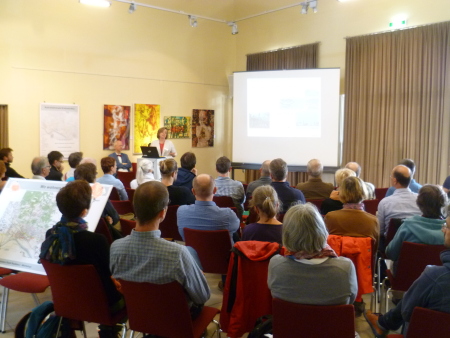
Intensive involvement of the population is planned during the course of the project. Two workshops are to be held in 2019, in which all interested Radebeul residents will be given the opportunity to participate.

© pixabay

Kick-off workshop from 29 May 2019
© Stadtverwaltung Radebeul