The walk begins at the tram stop (Line 4) or the suburban railway station at Radebeul-West (Line S1).
Head south along Bahnhofstraße and at the end of the road you will arrive at Altkötzschenbroda village green. You should spot the "Goldener Anker" hotel which was first mentioned in written records in 1497 as a "Hereditary Brewery." The building has repeatedly fallen victim to village fires. Throughout its varied history the building has served as a public house, concert and ballet venue, a meeting place for community leaders, and as a furniture shop in the 1970s. After extensive restoration work in 1999 the hotel complex, complete with its own ball room, is once again resplendent. The steel fountain sculpture "Against the Current" was installed in the same year by Karl Menzen (Berlin).
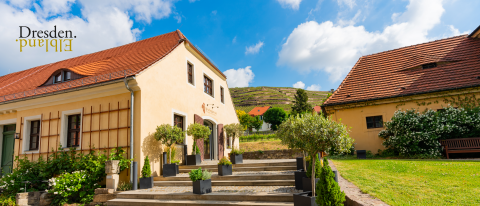
Stroll through the square and discover the many lovingly restored three-sided farm buildings. The construction of the village square is similar to that of a Franconian one-street village, characterized by narrow, low-lying farmsteads with gable-ends onto the street. Most of the preserved timber-framed farm houses and cottages with massive basements date back to the 19th century. The most striking buildings on the village green include the Friedenskirche church, the parsonage, the Oberschänke inn and the "Goldener Anker" hotel.
In the 1970s the entire historic heart of the village was earmarked to give way to a pre-fabricated housing development. Students from the Dresden University of Technology came up with the initial alternative designs. In 1994 Altkötzschenbroda was declared an urban preservation area. From 2000 onwards the village green has been transformed into an architectural gem. Around the square, old-fashioned pubs, gourmet restaurants, cafes, B&Bs and hotels opened their doors. Today Altkötzschenbroda is one of the most popular destinations for visitors from near and far.
At the eastern end of the village green is the Friedenskirche, the oldest church building in the Lößnitz.
It was first documented in 1273, and later destroyed by the Hussites before being rebuilt in a late Gothic style in 1477. In 1637 it was almost entirely destroyed once again during the Thirty Years War. The reconstruction was carried out in the Renaissance style, and was completed in 1656. The name "Friedenskirche" (Peace Church) dates back to the ceasefire agreement signed between Saxony and Sweden in the nearby parsonage in 1645, an event which is commemorated with a small memorial room in the church tower. Between 2003 and 2005 the church was partially renovated, and was given new bronze bells because the old ones had been melted down during WWII and replaced with iron versions.
On the way back towards the "Goldener Anker" you should cast a glance in the direction of the building at Altkötzschenbroda 21, as this is home to the town gallery (Stadtgalerie). The two-story gallery building and romantic courtyard housing the local history museum provide a wide range of options for exhibitions of paintings, graphics, sculpture and history.
At the end of the village square at the "Bürgergarten" pub turn left onto Uferstraße and continue straight ahead. You will soon encounter the Saxon Paddle Steamer fleet's landing slip. This is where the historical paddle steamers regularly dock on their way between Dresden and Diesbar-Seußlitz. The view from the ships provides a fascinating glimpse of the picturesque vineyards along the Elbe.
Your route continues along the Elbe cycling trail, lined with numerous community gardens, until you come to the turn-off at "Vierruthenweg." You should follow this path and then turn right onto Niederwarthaer Straße. Continue straight ahead until you come to the "Zum Hirsch" restaurant, which specialises in game, and continue onwards, crossing the road until you reach the village green of Altnaundorf. The circular center with a regular, typically Franconian village green originally included some 30 farmsteads. In the middle of the green is the village pond which was laid in 1822 following a devastating fire in the village. The last quarter of the 19th century saw a rapid increase in the number of residents of Altnaundorf, which meant that work began on a new school building in 1878. In the various courtyards there are numerous little wine cellars which can be hired for private celebrations.
At the end of the village green turn right onto Johannisbergstraße, and then turn left at the end, before heading through the pedestrian tunnel which will bring you out at the tram stop (Line 4) in the direction of Weinböhla or Dresden.
Distance: approx. 5 km
Duration: 2-2.5 h
Difference in elevation: 0 m
Level of difficulty: Easy